How long is 1 inch 1 inch is equal to 2.54 centimeters (25.4 millimeters). It is one of the most widely used units of length for measuring small objects in everyday life. Whether you’re checking product dimensions while shopping online, completing a school project, or working on a DIY task, understanding the actual size of one inch can help you make more accurate estimates.
Although one inch is a small measurement, it is used in countless products, including electronics, furniture, tools, clothing accessories, and household items. The easiest way to understand its size is by comparing it with familiar objects that are close to one inch long or wide. In this guide, you’ll learn the exact measurement of one inch, its conversions, practical uses, and nine everyday objects that make this measurement easy to visualize.
📏 Quick Answers – How Long Is 1 Inch?
The quick answers above explain how long is 1 inch using the most common metric and imperial conversions. One inch is exactly 2.54 centimetres (cm) or 25.4 millimetres (mm), making it one of the world’s most commonly used units of length. These conversions help you estimate object sizes, compare dimensions, and switch between measurement systems with confidence.
1 Inch Conversion Table
| Unit | Equivalent to 1 Inch |
| Inches (in) | 1 |
| Millimeters (mm) | 25.4 |
| Centimeters (cm) | 2.54 |
| Meters (m) | 0.0254 |
| Feet (ft) | 0.0833 |
| Yards (yd) | 0.0278 |
| Miles (mi) | 0.0000158 |
| Micrometers (µm) | 25,400 |
| Nanometers (nm) | 25,400,000 |
Key Takeaways
- One inch is exactly 2.54 centimeters.
- One inch is exactly 25.4 millimeters.
- It belongs to the Imperial and U.S. Customary measurement systems.
- Inches are commonly used for measuring electronics, furniture, tools, and everyday household items.
- Everyday objects provide a quick way to estimate one inch when a ruler isn’t available.
- For precise measurements, always use a measuring tape or ruler.
Why You Should Know the Size of 1 Inch
Knowing the actual size of 1 inch is useful in many everyday situations. Whether you’re buying products online, comparing furniture dimensions, measuring craft materials, or helping children with schoolwork, understanding this measurement allows you to estimate sizes more confidently.
Many product descriptions list dimensions in inches, especially for electronics, hardware, and home improvement items. Having a clear mental picture of one inch helps you avoid mistakes and choose products that fit your needs.
Where Is 1 Inch Commonly Used?
One inch may seem like a small measurement, but it is used in many industries and daily activities.
You’ll often see inches used for measuring:
- Mobile phone accessories
- Laptop and monitor screens
- Television displays
- Furniture dimensions
- Picture frames
- School supplies
- Plumbing fittings
- Screws and bolts
- DIY projects
- Sewing materials
- Product specifications in online stores
Understanding this unit makes it easier to compare dimensions and understand product sizes before making a purchase.
How Big Is 1 Inch Compared to Everyday Objects?
The easiest way to picture one inch is by comparing it with objects you use every day.
| Everyday Object | Approximate Size |
| Adult Thumb Width | 0.9–1.1 inches |
| Standard Plastic Bottle Cap | 0.95–1.1 inches |
| Small Paper Clip | Around 1 inch |
| Large Clothing Button | Around 1 inch |
| Standard Gaming Dice | 1 inch |
| USB Flash Drive Width | Around 1 inch |
| Metal Key Ring | Around 1 inch |
| Small Binder Clip | Around 1 inch |
| Large Postage Stamp | Around 1 inch |
Read More: Inches Measure
9 Everyday Objects That Are About 1 Inch Long
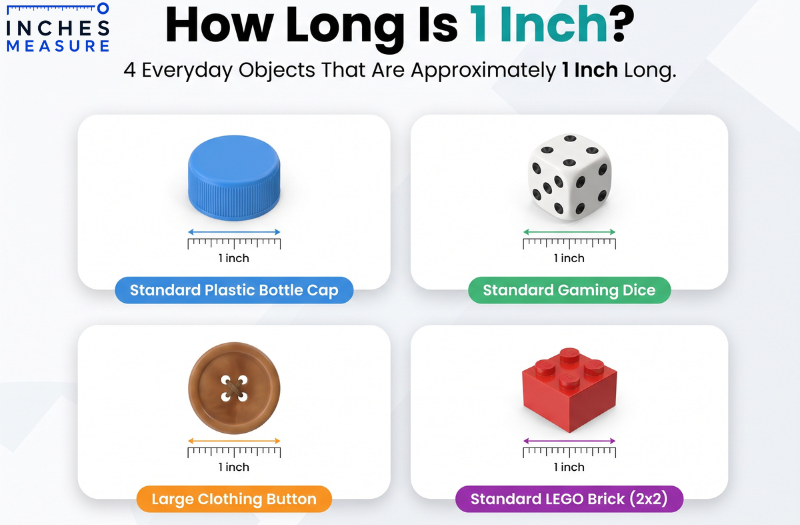
1. Standard Plastic Bottle Cap

A standard plastic bottle cap is one of the easiest objects to use when estimating 1 inch. Most water bottle caps measure close to one inch in diameter, making them a convenient size reference that you can find almost anywhere. While the exact dimensions vary slightly between manufacturers, the difference is usually very small.
Because bottle caps are commonly found in homes, offices, schools, and restaurants, they provide a quick way to visualize one inch without needing a ruler. They are especially helpful when estimating the size of small round objects, craft materials, or household accessories.
2. Standard Gaming Dice

A standard six-sided gaming dice is one of the most accurate examples of a one-inch object. Most board game dice measure approximately one inch on each side, making them ideal for understanding this measurement from every angle.
Its cube shape makes it easier to compare the length, width, and height of other small objects. If you have a board game at home, a gaming dice is one of the best references for estimating one inch accurately.
3. Large Clothing Button

A large decorative clothing button found on coats or jackets often measures close to one inch in diameter. These buttons are larger than regular shirt buttons and are manufactured in standard sizes, making them a useful comparison object.
If you’re working on sewing projects or crafts, comparing materials with a large clothing button can help you estimate one inch quickly. Although button sizes vary slightly, most outerwear buttons stay close to this measurement.
4. Standard LEGO Brick (2×2)

A standard 2×2 LEGO brick measures close to 1 inch in both length and width, making it a useful everyday reference for this measurement. Since LEGO bricks are manufactured with high precision, they have consistent dimensions and are often used in educational activities, model building, and creative projects.
If you have LEGO bricks at home, you can use one to estimate the size of small toys, craft materials, or desk accessories. While larger LEGO pieces come in different sizes, the standard 2×2 brick is one of the easiest objects to compare with one inch.
5. A Quarter-Sized Cookie Cutter

Many small cookie cutters used for baking measure around 1 inch across. These cutters are commonly used to create miniature cookies, fondant decorations, and cake toppings, making them a helpful reference when estimating small dimensions.
Because cookie cutters are made in standard sizes, they provide a reliable comparison for one inch. They are especially useful when measuring baking decorations, craft materials, or other small circular objects around the kitchen.
6. A Small Eraser Cube

A small cube-shaped eraser found in many stationery sets is often close to 1 inch in length. These erasers are commonly used by students, artists, and office workers, making them another familiar object for understanding this measurement.
Their compact shape makes them useful for comparing the size of desk accessories, school supplies, and other small items. Although some erasers are larger or thinner, many standard cube erasers remain close to one inch.
7. A Wooden Alphabet Block

A wooden alphabet block used in children’s educational toys typically measures about 1 inch on each side. These blocks are designed to be easy for children to hold while remaining compact enough for stacking and learning activities.
Because each side is nearly the same length, an alphabet block provides a simple visual reference for estimating one inch. It is also useful for comparing the dimensions of small boxes, containers, and other cube-shaped objects.
8. A Chess Pawn Base

The base of a standard chess pawn measures close to 1 inch in diameter on many chess sets. Since chess pieces are manufactured in standard tournament and recreational sizes, the pawn base offers another practical comparison for this measurement.
If you enjoy board games, you can use a chess pawn to estimate the size of small round objects, decorative items, or craft materials. Keep in mind that travel chess sets may use smaller pieces.
9. A Small Square Sticky Note

Some mini square sticky notes measure approximately 1 inch by 1 inch. These notes are commonly used for page markers, reminders, and organizing documents, making them another everyday example of this measurement.
Their square shape makes it easy to compare both height and width when estimating one inch. Since sticky notes are inexpensive and widely available, they provide a convenient reference in homes, schools, and offices.
Common Mistakes When Estimating 1 Inch
Estimating one inch using everyday objects is useful, but there are a few mistakes you should avoid.
- Assuming every object is exactly one inch.
- Using oversized or miniature versions of common items.
- Forgetting that manufacturers may produce different sizes.
- Estimating important measurements without checking with a ruler.
- Comparing objects from different brands without considering slight variations.
Using everyday objects works well for quick estimates, but precise measurements always require a ruler or measuring tape.
How Accurate Are These Comparisons?
| Everyday Object | Approximate Size | Accuracy |
| Standard Gaming Dice | 1 inch | ⭐⭐⭐⭐⭐ |
| Standard LEGO Brick (2×2) | About 1 inch | ⭐⭐⭐⭐☆ |
| Plastic Bottle Cap | 0.95–1.1 inches | ⭐⭐⭐⭐☆ |
| Wooden Alphabet Block | About 1 inch | ⭐⭐⭐⭐☆ |
| Chess Pawn Base | Around 1 inch | ⭐⭐⭐⭐☆ |
| Small Sticky Note | About 1 inch | ⭐⭐⭐⭐☆ |
| Small Eraser Cube | Around 1 inch | ⭐⭐⭐⭐☆ |
| Large Clothing Button | Around 1 inch | ⭐⭐⭐⭐☆ |
| Small Paper Clip | Around 1 inch | ⭐⭐⭐☆☆ |
How to Measure 1 Inch Without a Ruler
Compare With Everyday Objects
Objects such as a bottle cap, gaming dice, LEGO brick, or wooden alphabet block provide a quick visual estimate of one inch.
Use Your Hand as a Reference
For many adults, the width of a thumb is close to one inch and can be used as a rough measuring guide.
Compare Multiple Objects
If two or three different reference objects appear to match the same size, your estimate is likely to be more accurate.
Check Product Dimensions
Many product packages include measurements in inches. Comparing an unknown object with a labeled product can help you estimate its size more confidently.
Interesting Facts About 1 Inch
- One inch has been officially defined as exactly 25.4 millimeters since 1959.
- The inch is part of the Imperial and U.S. Customary systems of measurement.
- There are 12 inches in one foot.
- There are 36 inches in one yard.
- Screen sizes for TVs, monitors, and laptops are measured diagonally in inches.
- The word inch comes from the Latin word “uncia,” meaning one-twelfth.
Expert Tips
- Learn two or three everyday references instead of relying on just one.
- Use everyday objects only for rough estimates, not precision work.
- Keep a small ruler in your desk, backpack, or toolbox for accurate measurements.
- Double-check measurements before purchasing furniture, electronics, or DIY materials.
FAQs
How long is 1 inch in centimeters?
One inch is exactly 2.54 centimeters.
How many millimeters are in 1 inch?
There are 25.4 millimeters in one inch.
What object is closest to 1 inch?
A standard gaming dice is one of the closest everyday objects to exactly one inch.
Is 1 inch bigger than 2 centimeters?
Yes. Since 1 inch equals 2.54 centimeters, it is slightly larger than 2 centimeters.
Can I measure 1 inch without a ruler?
Yes. You can estimate it using common objects such as a bottle cap, LEGO brick, gaming dice, or your thumb.
Why is the inch still used today?
The inch remains widely used in construction, manufacturing, electronics, and many consumer products, especially in countries that follow the Imperial system.
Read More: Inches Measure
Conclusion
Understanding how long 1 inch is becomes much easier when you compare it with familiar everyday objects. Whether you use a bottle cap, gaming dice, LEGO brick, alphabet block, chess pawn, or sticky note, these references help you estimate one inch quickly and confidently.
While these comparisons are useful for everyday situations, they should only be used as rough guides. Whenever accuracy matters, always measure with a ruler or measuring tape. By remembering a few common one-inch objects, you’ll find it much easier to judge sizes while shopping, studying, crafting, or completing DIY projects.